
When the bed headboard becomes intelligent
There is a moment, in every hospital ward, that repeats dozens of times a day and says more than any statistic. It's when the doctor approaches the bed during rounds and, in a few seconds, has to reconstruct the clinical picture of the person in front of them. Blood pressure, heart rate, oxygen saturation, temperature: numbers scattered across different monitors, charts, displays that aren't always aligned. Those few seconds, multiplied by every patient and every shift, add up to a great deal. And too often they are spent searching for the information rather than reading it.
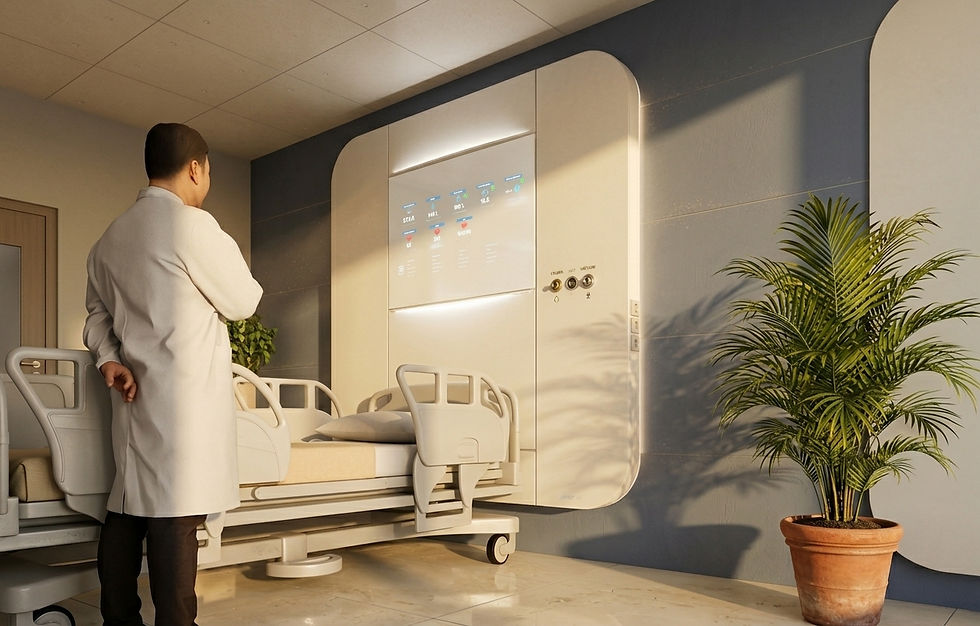
It was from this observation that the project I've been working on was born: an advanced bed headboard — an equipped wall unit with a backlit screen that presents a patient's vital parameters in an immediate, ordered and instantly comprehensible way. I called it KLAI.
From the number to its meaning
The challenge wasn't technological in the most obvious sense. The sensors exist, the data is there, hospitals collect it in enormous quantities. The real problem is a different one: turning that data into understanding. A single value says little; what matters, for those providing care, is the trend. A blood pressure that has been slowly dropping for three hours tells a different story from one that is low but stable. A saturation level that keeps fluctuating is a signal that a single, static number simply cannot convey.
That's why I designed KLAI not as a display that shows figures, but as a surface that shows trends. The backlit screen, integrated into the wall at the head of the bed, presents vital parameters in a visual hierarchy built so that the doctor understands, in a single glance, not only how the patient is right now, but in which direction their state of health is moving. It's the difference between reading a photograph and reading a film.
Design as a clinical act
Thirty-five years of work as a designer and visualizer have taught me something that holds as true for architecture as it does for medicine: form is not decoration, it is function made legible. A poorly designed interface, in a ward, isn't simply ugly — it is slow, ambiguous, potentially dangerous.
Every choice in KLAI stems from this principle. The backlighting isn't there for effect: it's there to guarantee legibility even in difficult lighting conditions, at night, from a distance, without straining the person looking at it. The arrangement of the parameters follows the way a clinician actually reasons, not the order in which a sensor transmits. The colours, the contrasts, the size of the characters are conceived to be decoded in fractions of a second, because on the ward, reading time is time taken away from care.
The equipped wall unit also brings together, in a single element, what today is fragmented. The headboard becomes the point where design, ergonomics and medical technology converge: an object that is part of the environment, yet works as a clinical instrument in its own right.
The collaboration with Lomar
An idea, on its own, heals no one. To move from concept to a real product — one capable of belonging in a hospital and meeting its standards — you need an industrial partner who genuinely knows the sector. For several years now I have been collaborating with Lomar, a company specialising in the manufacture of hospital medical equipment and devices, on the development of new products.
It's a collaboration that works because it brings together complementary expertise: I contribute the design vision, an obsession with legibility and the experience of making complex things comprehensible; Lomar contributes its knowledge of the hospital world — the materials, the regulations, the production processes and everything that separates a beautiful rendering from a device that can truly enter a ward. KLAI was born precisely in that meeting point, where design meets medical engineering and lets itself be tested against clinical reality.
A direction, not just a product
I like to think of KLAI as a first step. The idea of a care environment that communicates — that returns information in a human, immediate way — doesn't end with a single object. It concerns how we conceive hospital space: no longer a container of machines, but a system that supports the work of those who provide care and, indirectly, the experience of those being cared for and of the people beside them.
There is something deeply consistent, for me, in this project. I have always worked on the idea that the best technology is the kind that disappears — that lets itself be read without demanding effort. A headboard that tells the truth about a patient's condition with the same ease with which we read the time on a clock is, ultimately, exactly that: technology that turns into silence, so that all attention can remain where it belongs — on the person.
KLAI is a project developed in collaboration with Lomar, a company active in the production of hospital medical equipment and devices. For information and enquiries: info@lomar360.com
Comments